

202627 Tug connection gone wrong
A cargo vessel in ballast arrived in a port to enter a shipyard under the guidance of a pilot. The pilot and Master agreed on a manoeuvring plan. The two tugs in attendance were to accept two mooring lines each, from the bow and stern central chock of the vessel respectively. The two lines were supposed to be passed to each attending tug together as one.
At the arriving vessel’s stern, this was done quickly. At the bow, only one line was given to the attending tug forward. This line was attached to the tug’s towing hook and, unknown to the tug Master, it was made fast on the arriving vessel. While waiting for the second mooring line, the tug passed dangerously close to the port bow of the vessel. The two personnel in the tug’s towing area had to move around to avoid the risks posed by the line that had been secured.
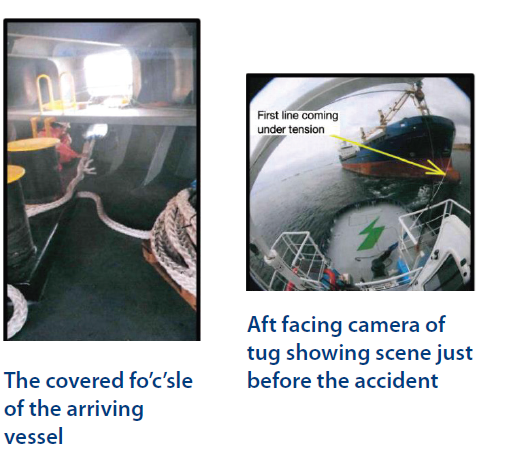
The forward tug then manoeuvred to take the second mooring line, which was now suspended from the bow of the vessel. As the tug manoeuvred, the line already secured came under strain, again coming dangerously close to the two seafarers on the stern of the tug. One of them ducked, and the mooring line made a glancing blow on his helmet, knocking it off his head. The deck hand next to him was struck in the chest by the line under tension and seriously injured. The stretched line then pulled the tug towards the vessel and caused the tug to contact the vessel.
The uninjured seafarer released the line using the emergency release device on the hook. He also reported the events to the Master at the controls. The tug Master immediately reported the situation to the pilot and the pilot station and requested an ambulance. The victim was quickly transported to the dock, and medical teams were mobilised. The victim was in a serious condition and was taken to the hospital by the paramedics without delay. Despite all efforts the victim succumbed to his injuries.
The investigation found, among other things, that the enclosed forecastle deck of the arriving vessel made it difficult for the crew on the fo’c’sle deck to establish effective communication or eye contact with the crew on the stern of the tug. The investigation also found that the tug company should establish procedures for situations where the mooring lines cannot be given at the same time, including precautions to be taken by the tug personnel.
Lessons learned
- Line handling operations are very common but inherently hazardous for tug crews. Thorough failsafe procedures, crew compliance with the procedures and excellent communication are the touchstones for crew safety.
- There is no substitute for visual observation from one vessel to the other to inform the situational awareness of all involved.