

202633 Collision in a TSS
As edited from MAIB (UK) report 7/2018
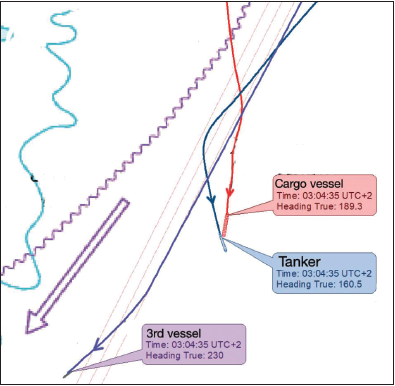
A bulk carrier was overtaking an oil tanker in a Traffic Separation Scheme (TSS) at night, in good visibility. The bulk carrier, moving at over 16 knots, had already passed several slower vessels that evening and was closing on the tanker from astern. A third vessel was also ahead, and was also passing the tanker. The bulker’s bridge team – Master, OOW, and a lookout who had briefly left the bridge – had focused on each overtaking situation individually rather than maintaining long-range radar and ECDIS scanning.
As the range to the tanker closed to under a mile, the bulk carrier’s Master became concerned about the tightening CPA. He asked the OOW to call the tanker on VHF to establish intentions. The resulting conversation, conducted in English by non-native speakers, was ambiguous and each bridge team came away with opposite understandings. The tanker’s Master believed the agreement was that they would ease slightly to port while the bulk carrier passed them to starboard. The bulk carrier’s OOW, relaying the conversation in his own language to his Master (who had not listened to the call directly), reported the opposite: that the tanker did not want to be passed to starboard.
Acting on this second-hand understanding, the bulk carrier’s Master ordered a gradual series of small helm movements to port, now intending to pass down the tanker’s port side. No sound signals were made, and the manoeuvre was carried out incrementally; it went unnoticed by the tanker’s bridge team.
Meanwhile, the tanker’s Master – who had been on the bridge continuously for over 14 hours and was probably fatigued – was preoccupied with a separate crossing vessel on their port bow and a narrowing turn in the TSS ahead. Believing the bulk carrier would pass safely to starboard, he ordered hard-to-port to begin a full round turn to increase his sea room with the crossing vessel. Unfortunately, a visual check astern and a sound signal were not made before the turn began.
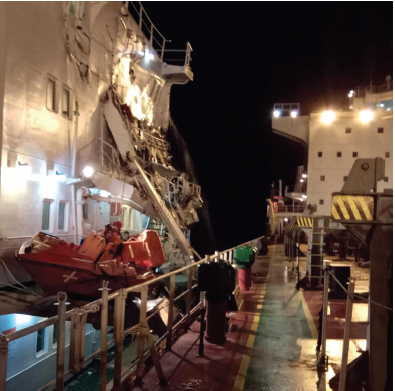
Only when the tanker’s lookout spotted the bulk carrier close on the port quarter did the bridge team realised the danger. Both vessels attempted last-minute avoiding action, but with neither team understanding the other’s intentions, a collision ensued. Both vessels sustained significant structural damage but there were no injuries or pollution.
Lessons learned
- VHF is not a substitute for compliance with the Collision Regulations. It should only be used, if at all, early enough to allow a resolved, unambiguous plan to be established – not as a late-stage fix for a closing CPA.
- If the officer with the con delegates a VHF exchange to another, they should listen to it directly rather than relying on a second-hand summary, particularly where a language relay is also involved.
- Unambiguous course alterations should be made decisively, not through a gradual series of small helm orders.
- Before any large alteration of course, always check for traffic in the direction you are about to swing into – including astern.
- The Collision Regulations require long-range scanning, not just short-range collision avoidance. This would in this case have allowed earlier, larger, and less ambiguous action.
