Free Article: Handing over
The Nautical Institute AGM 2026
by Trevor Bailey FNI, Immediate Past President
My presidency started in Manila, just under two years ago, where we had a fantastic conference and AGM, and from where I headed straight off to sea, flying back to Athens to join a ship as Master the following day. I have continued throughout my presidency as a semiactive seafarer, but certainly an active participant in the maritime industry. I’m a full-time employee of Windstar Cruises and I have sailed in command of all but one of our ships, as well as spending a lot of time in the shipyard when we took delivery of our new ship at the end of December last year.
Along with this, I’ve tried to mix in the requirements and requests to the President to attend various events around the globe, both in person and online. I’m very grateful to my Senior Vice President Walter Vervloesem, who has stepped in for me in person for a number of those events, and to the rest of my colleagues in the presidential team who have also supported me throughout my time in office.
Welfare and human factors
Like all presidents of The Nautical Institute, I had a number of themes I wanted to address over the course of my presidency and I want to reflect on what we may or may not have achieved in that time.
One of those themes was concern for welfare and human factors. Current world events have had a very grave impact on the welfare of seafarers at the moment, as we know only too well. The conflict in the Straits of Hormuz means that there are many, many seafarers who are stuck in that region.
At The Nautical Institute, we continue our representation through the IMO to voice our concerns. We’re not a political organisation, and we don’t have a loud voice in this particular area, but we do support every possible effort to look after our seafarers wherever they are.
I also said that we needed to look at alternative fuels, how they are used and how seafarers are trained to use them. This is an area that continues to develop. As I noted in my Focus piece for Seaways last month, the development of alternative fuels may be accelerated by what is happening in the Gulf if the availability of fuel becomes a problem. A related problem is that ships are being diverted around the Cape and spending longer at sea, and therefore potentially causing a greater demand for fuel.
IMO connections
We have worked very closely on both these issues with the IMO, and we’re also working hard on the revision of STCW. That is taking much longer than anybody anticipated, but be assured that the Institute is represented in those discussions.
To me, that representation at the IMO is one of the most important aspects of our work at The Nautical Institute in supporting our members. We are the voice of the seafarer, the voice of the end user, asking questions like is this regulation fit for purpose? What will be the impact on our members of these changes in legislation? Captain Chris O’Flaherty does an amazing job there, and he’s helped at all committee meetings by volunteers from across the membership.
We’ve established a great relationship with the current Secretary General, Arsenio Dominguez. I was very fortunate to be able to meet him in person shortly after he was appointed to office, and it was a great delight to welcome him to Nautical Institute headquarters to address our joint governance meeting in 2025. That’s probably the highlight of my presidential career – despite my managing to fall down the stairs as we welcomed him in.
As you will have seen in the Seaways interview, the Secretary General very much values the voice of the seafarer in all the deliberations at IMO and he is keen to have more seafarers in the delegations. For the young members with us, there’s an opportunity for you. Get your sea time in, go and work at the IMO, get into your delegations and keep representing our voices.
Membership matters
Over the last two years, there has been a great effort on all parts to increase our membership and particularly our student membership. We now have just over 14,000 members worldwide, and the branches continue to expand. We’ve seen six new branches during my time, and one of Walter’s first tasks will be to go to Italy for the formal Branch launch in June.
One of my sad tasks as the president was to represent the Institute at the funeral of Captain Robbie Middleton, one of our former presidents, a former treasurer and a phenomenal influence on the Institute and to me personally. I feel I should give recognition to Robbie today.
I would like to thank all the members of Council who have supported me over the last two years – and who sometimes try and put me right, whether or not I listen! It will be a great pleasure to continue to sit on council for the next two years as the Immediate Past President, and to continue to meet regularly with The Nautical Institute Presidential Team, who all work together to try and make sure that we keep the Institute on track.
I also want to say thanks to the Younger Members Council. We see your dedication, and the value in all that you do. Thank you. The future is yours.
My grateful thanks, too, to the staff at Nautical Institute headquarters HQ. Without your tremendous efforts and support, I would not have achieved so much in my time in office – thank you.
In closing, thank you to all of you for your support during the last two years, and into the future.
by Walter Vervloesem FNI, Incoming President
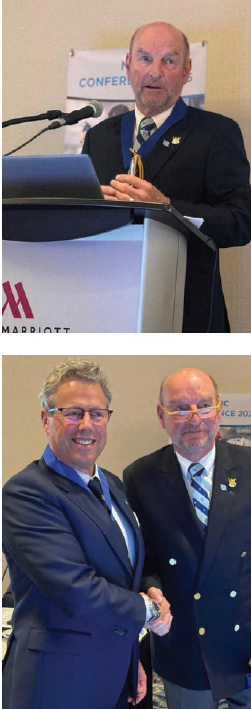
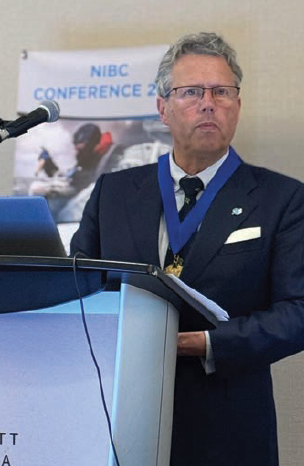
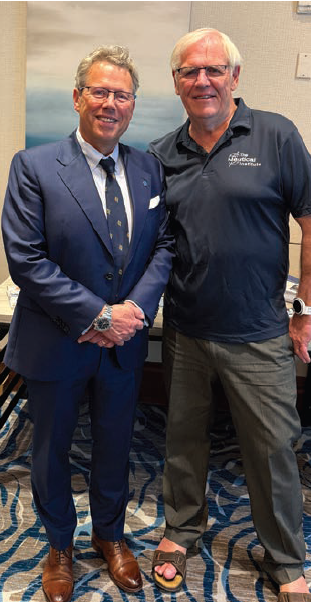
On 13 May 2026, I had the great honour of taking over the presidency of The Nautical Institute from Capt Trevor Bailey at The Nautical Institute’s AGM in Victoria, British Columbia, Canada.
As your new President, it is both a privilege and a responsibility to address our members through Seaways and to share with you the goals, priorities and aspirations that will guide my period in office.
From sea to surveyor
My own journey in the maritime industry began after graduating from secondary school, when I studied at the Antwerp Maritime Academy and later served at sea on different types of vessels. Those years gave me a deep respect for the sea and seamanship, for the realities of life on board and for the practical knowledge and skills that are essential to safe and efficient ship operations.
I later redirected my career into marine surveying, with a focus on ship and hatch cover inspections, cargo claims and loss prevention. It soon became clear to me that many cargo claims were caused by leaking hatch covers, cargo shift, collapse of stow and preventable shortcomings in cargo care. This led me among other things to pioneer ultrasonic hatch cover testing, which soon returned impressive success rates.
In 1995, I set up the IMCS Group, which has since grown into a global network of 18 survey and consultancy offices. Establishing the IMCS Training Academy was a natural next step, created to provide practical, hands-on training both for our own surveyors as well as external participants.
Today, as Chairman of the IMCS Group and Director of the IMCS Training Academy, I remain actively involved as a surveyor, consultant, and trainer, supporting practical training initiatives around the world. My continued work in the field keeps me closely connected to the realities of life at sea, as well as to the practicalities and challenges of shipboard operations in the broadest sense.
This background strongly shapes the message I wish to bring during my presidency.
Working with The Nautical Institute
My connection with The Nautical Institute has also been long and meaningful. Together with my colleague Capt Marc Nuytemans FNI, we established the Belgian Branch of The Nautical Institute in 1998 and have remained closely involved in its development and management ever since. Today, our branch has 120 members, including 40 student members, which is a source of real pride and optimism.
I have also had the privilege of authoring major reference works for The Nautical Institute, including Ship Survey & Audit Companion, Hatch Cover Inspections and Mooring & Anchoring Ships (Vol. 2), as well as co-authoring a number of other publications.
Over the years, my journey with The Nautical Institute has taken me from AMNI to MNI and FNI, through service as a Council Member, Vice President, and Senior Vice President, and now to the honour of serving as President. With more than 45 years of experience in this industry, extensive international travel, engagement and continued involvement with the Belgian Branch, I look forward to bringing that experience, energy and commitment to my role as President.
Finding a theme
During their term in office, Presidents work in support of The Nautical Institute’s Strategic Plan. Our current plan, covering the period 2026 to 2030, includes important priorities such as membership and branch growth, research and relationships, qualifications, information and publications.
In addition to these strategic priorities, each President also brings a presidential theme, a subject they wish to champion and share with the wider maritime community. My own background in ship inspections, hatch cover inspections, cargo claims and loss prevention has inspired my theme: ‘Supporting Net Zero Through Cargo Knowledge and Cargo Care’.
Today, the shipping sector rightly focuses much of its attention on alternative fuels, emissions reduction, and the transition towards zeroemission shipping. These are vital topics. However, I believe we must also remember something very simple and very important: shipping exists to move cargo.
Moving cargo drives the shipowner’s business model. Cargo supports global trade. Cargo brings prosperity to nations and communities around the world. Yet the environmental impact of cargo damage is still not sufficiently recognised.
Dry cargo ships make up more than 30% of the world fleet. They carry grain, ore, coal, fertiliser, steel and many other cargoes that are essential to daily life. These cargoes are valuable, but they are also vulnerable. Seawater ingress remains one of the major causes of cargo claims, mainly linked to leaking hatch covers, poor maintenance, incorrect operation or insufficient practical (basic) knowledge. Other risks are equally important: container losses, cargo shift, collapse of stow, usually caused by failures in stowage, lashing and securing. And of course, other types of cargo, carried on board different types of ships will also be vulnerable to cargo damage.
Such incidents may involve delays, emergency repairs, reputational damage, cargo damage and the unnecessary replacement of goods, but the environmental impact of cargo damage and loss should not be overlooked.
Producing cargo requires energy, resources, transport and labour. A damaged steel coil, for example, is not only a financial claim. It also represents the embedded energy, emissions, mining, manufacturing and logistics that went into producing it and the additional environmental impact of replacing it. The energy required to produce the cargo carried by a single ship can be comparable to the annual energy consumption of thousands of households – to say nothing of the associated CO2 emissions.
Ships that deliver damaged cargo at destination cannot be considered truly efficient. If shipping is to meet its net-zero ambitions, shipboard maintenance, cargo knowledge and cargo care must be treated as essential.
Alternative fuels will of course play a direct and vital role, but preventing cargo damage and reducing claims also contributes meaningfully to environmental performance. These are not separate issues; they are all part of the same journey.
For me, this theme is not theoretical. It is grounded in my own experience at sea, in surveying, in training, and in working with ships, cargoes, crews and companies around the world. Over the years, I have seen how much can be achieved when cargo knowledge, care and practical experience come together. I have also seen the cost, both financial and environmental, when they are missing.
Shared knowledge, shared responsibility
Good seamanship remains at the heart of this, supported by high operational standards, practical training, modern inspection techniques and a willingness to share experience. Yet many of the skills associated with cargo care are not covered consistently under STCW requirements or within maritime academy curricula. As a result, much of the necessary expertise must come from within the industry itself. This creates a shared responsibility: for companies to invest in competence, for professional bodies to support standards, for experienced mariners to pass on their knowledge, and for the wider maritime community to keep learning from experience.
This is where The Nautical Institute has such an important role to play. With our global membership of around 15,000, our international branch network and our deep pool of professional experience, the Institute is exceptionally well placed to lead this discussion. Together, our members represent hundreds of thousands of years of maritime knowledge and experience. Some have spent their lives building practical expertise at sea and ashore. Others are students and young professionals eager to learn. Through our branches around the world, The Nautical Institute can connect people, share lessons and knowledge, and promote best practice.
Cargo care and loss prevention bring together good seamanship, high standards, practical knowledge and modern techniques. This is exactly what The Nautical Institute stands for.
The challenge before us is significant, but so is the opportunity. By strengthening cargo knowledge and cargo care, we are not only gearing up the next generation to meet the challenges ahead, we are also making a tangible contribution to a more sustainable maritime industry and supporting net zero in a practical, measurable, and meaningful way. This is why I believe that enhanced cargo knowledge and cargo care must be recognised as a direct contribution to decarbonisation. The essential purpose of shipping has always been to move cargo safely, efficiently, and responsibly.
As I begin my time in office, I would like to call on all members of The Nautical Institute to contribute to this journey because it is so important. While tradition remains our anchor, it is our responsibility to set the course for the future. Technology and alternative fuels are vital in the transition to net zero, but they will not decarbonise shipping on their own. Skilled, informed and committed maritime professionals will make the difference.
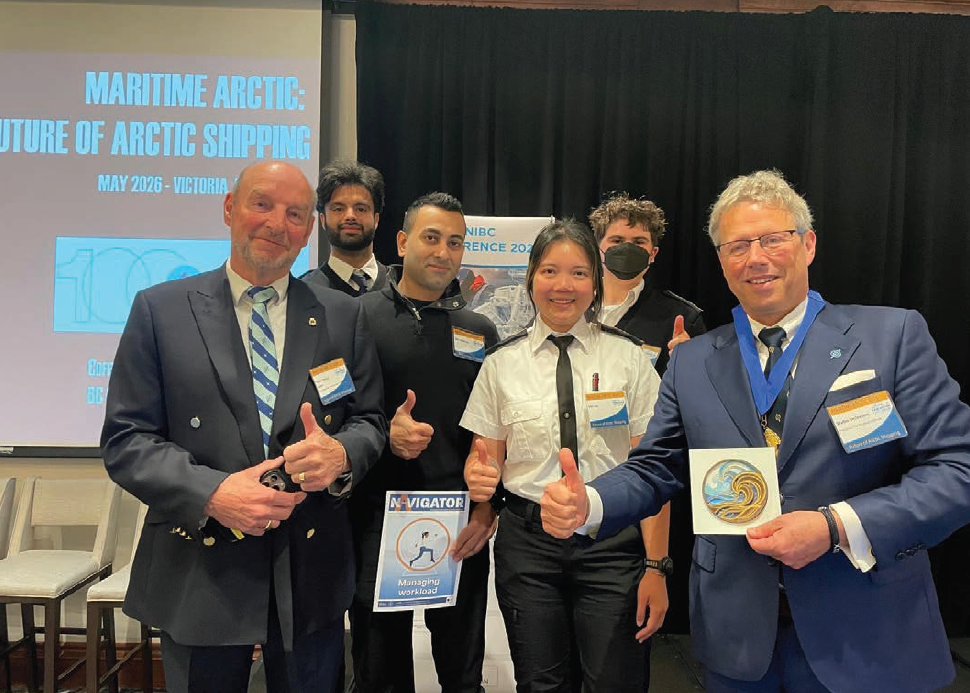
Thumbs up
I concluded my presidential address with one particular promise to the audience: throughout my presidency, I would like to be known as the ‘thumbs-up’ President. Whenever I have the honour of representing The Nautical Institute, whether at a major conference, a branch event, a seminar or a smaller gathering, I intend to mark the moment with a thumbs-up photo. Not merely for the image itself, but for what the gesture represents: reliability, trust, encouragement and confidence. Above all, it reflects a shared sense of fraternity and direction; a belief that there is a plan, that we are moving with purpose, and that we are ready to move forward together.
I look forward to being your President, to working with you during my time in office and beyond, and to helping The Nautical Institute continue to inspire, support and empower maritime professionals and our maritime industry around the world. Let’s make a difference... together!