

202635 Have you looked at your lashing hook?
Lashing hook/D-ring incompatibility leads to cargo fires
A bulk carrier was underway with a cargo of lithium-ion battery energy storage system (BESS) units and heat exchangers stowed in two cargo holds. Each BESS unit was secured with four polyester ratcheted lashing belts. These were hooked to D-rings that were held in place by brackets welded to the deck.
While transiting the North Pacific in heavy weather, the vessel rolled severely and shipped water over the hatches. The Master altered course to allow the crew on deck to check the cargo. They found that several BESS units on the tween deck of one hold had broken loose and shifted.
At around the same time, the chief officer saw black smoke coming from a manhole cover into the same hold that had just been opened. The alarm was sounded and the crew mustered. Once the second hold was confirmed clear of fire, and the first hold’s ventilation secured and the space vacated, the Master ordered a full discharge of the fixed CO2 system into the affected hold. The fire was declared extinguished later that day, and the crew re-lashed the units that had shifted.
Three days later, again in heavy weather, a fire alarm sounded for the second cargo hold and smoke was seen coming from its ventilation. With no CO2 remaining, the vessel’s course was altered to reduce rolling and pitching. Crew then sprayed the hold exterior with seawater for several hours until infrared checks confirmed the temperature was falling. The vessel proceeded to a port of refuge, where the fires were confirmed extinguished. No injuries had occurred, but damage was later estimated at $3.8 million. The investigation found that 41 of the 160 BESS units on the tween decks had broken loose, and three of these had suffered an internal fire.
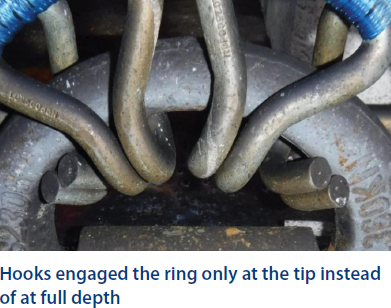
A mismatch between the lashing belt hooks and the D-rings was the main contributing factor. The D-rings were too large in diameter for the hook throats, so only the tip of each hook engaged the ring instead of its full depth. This concentrated load at the bend of the hook rather than spreading it across the throat, and hooks began to fracture under the motion of the ship. As each hook failed, the remaining hooks and welded brackets on the unit took increasing load, leading to further hook fractures and, in some cases, brackets tearing away from the deck.
Once free of their lashings, the units shifted and struck each other and the ship’s structure. The now damaged battery packs and their exposed busbars contacted the unit’s internal structure, shortcircuiting the cells. This triggered thermal runaway in three units, producing the fires.
The mismatched hook-to-D-ring fitment had not been identified as a risk by the crew, the stevedores, or the parties overseeing the cargo securing, since the storage and lashing plan specified only the required breaking load and not the physical compatibility of the fittings.
Lessons learned
- Fittings – hooks, D-rings, shackles – must be checked for physical compatibility. A hook that cannot fully seat on a ring will concentrate the load at its weakest point and may not hold to its rated strength.
- Cargo securing plans and pre-departure inspections should include a check that lashing hardware is correctly matched, not only that it is rated to the required load.
- Lithium-ion battery cargo that breaks free and suffers internal structural damage is at risk of thermal runaway and fire, even where the packaging shows only modest external damage. Internal shelf and rail deformation may not be visible from outside.
As edited from NTSB (USA) report MIR-25-41 IMO GISIS occurrence number not yet assigned
