

202628 BRM under pilotage takes a dive
Expectation bias + weak BRM = two groundings
A fully laden bulk carrier was upbound in a tidal river under favourable tidal conditions and with a tug escort. During the initial leg of the transit, pilot A noted that the ship, loaded to 11.7 m draft fore and aft, was difficult to handle and required substantial, early rudder to control its swings. The channel had a dredged depth of 12.2 m which left only 0.5 under keel clearance (UKC) before considering squat. Pilot B boarded the vessel to relieve pilot A. The outgoing pilot advised him that the vessel needed substantial rudder to steer and recommended early initiation and counter rudder for turns.
Pilot B found the vessel challenging to manage, noting that it frequently tended to, in his words, ‘dive to port’. He began intentionally manoeuvring the vessel outside the starboard side of the channel, expecting that the flood current north of the next bridge would push the ship toward the port side, where numerous piers protruded close to the channel boundaries. Actual environmental data later revealed that the real-time tide level was less than half of what had been predicted, meaning the actual current pushing the vessel to port, back toward the channel, was likely much weaker than the pilot anticipated.
As the vessel passed under the bridge its centreline drifted about 42 metres outside the channel to starboard. Despite issuing some port rudder commands to correct the course, pilot B also compensated with starboard rudder orders to prevent what he expected to be a sharp port swing.
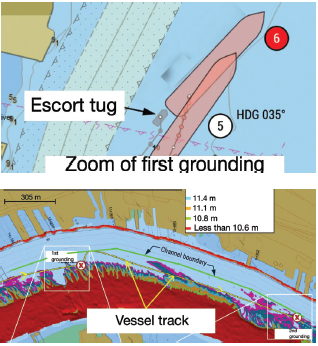
Two and a half minutes later, the vessel’s bow was now some 88 metres outside the channel to starboard when, suddenly, its speed dropped (position 6 below). The crew felt a jerk and heard a rumble; the vessel had touched bottom. The Master pointed out that they were out of the channel. The pilot used a series of aggressive engine and rudder manoeuvres and assistance from the escort tug pushing on the starboard bow to free the vessel and resume moving forward. This ‘refloating’ took about six minutes.
Once back underway, the pilot continued navigating roughly parallel to the dredged channel, keeping the bulk carrier about 75 metres to starboard of the channel limit. As the ship accelerated, the Master repeatedly voiced concerns regarding their position, but the pilot reassured him that they were returning to the channel and that everything would be fine. About 8 minutes after coming free from the first grounding, the Master pointed out a red channel buoy nearly dead ahead on the starboard bow; they were running directly into shallow water. At about 6.5 knots, vibrations were heard and felt throughout the ship and the Master told the pilot that the ship needed to come to port. The pilot responded yes, but he was ‘running out of room’. Moments later, the crew heard air rushing from the bilge tank vents as the bottom shell plating ruptured on underwater shoals. Some two minutes later the vessel came to a complete stop, hard aground and listing to starboard due to the flooding of multiple ballast and fuel tanks. The vessel remained aground for three days before being refloated.
The official report found, among other things, that the pilot might have suffered ‘Expectation bias’, when a person responds in a way that is consistent with what they expect rather than what is actually occurring. He expected the vessel would be pushed to port by the current, and he also expected the vessel to ’dive to port’. He overcompensated and manoeuvred the vessel further outside the channel to starboard. After the first grounding, he continued to manoeuvre the vessel well to starboard of the channel even after the Master warned the pilot that the vessel was in danger, until the vessel grounded again.
Lesson learned
- Pilots are human and can make mistakes. In this case the current pushing the vessel to port was not nearly as strong as predicted, and navigating outside the dredged channel to starboard only aggravated the hydrodynamic interactions.
- With only 0.5m of UKC before considering squat, the vessel was probably ’diving to port’ due to the stern experiencing bank suction. This phenomenon intensifies with the vessel’s speed, and was aggravated by conning the vessel to starboard of the channel.
- Strong BRM with a pilot on board is often a challenge, but this is the tool crew must use to avoid single point failure (ie the pilot making all decisions without challenge). Bridge officers, even Masters, are often hesitant to intervene with a local area expert at the con.
- When a pilot and bridge team clearly and openly share necessary information, both before and throughout a manoeuvre, they establish a shared mental model that increases collective situational awareness. Unexpected actions or deviations from the plan should be discussed between the crew and pilot to ensure a mutual understanding of the situation and prevent unrecoverable errors.
- Although the escort tug was equipped with azimuth drives, it does not appear, from the report, that the tug was used as an active aid for steering but simply as a ‘Plan B’ in case of an emergency. In many ports, eg Halifax (Canada), a tethered tug aft is often employed by pilots in the indirect towing manner as an active aid to steering, or even as a brake to reduce speed over ground (SOG) while the pilot increases engine RPM to increase rudder response.