
202624 Fatigue contributes to catastrophe
Tanker A was underway in a traffic separation scheme (TSS) in good weather and with visibility of about 10 to 12 nautical miles (nm).
At approximately 0224, the Master handed over the con and navigational watch to the OOW but remained on the bridge. The OOW on duty had joined the vessel the day before and this was his first watch.
At about 0430, satisfied with the OOW’s familiarity with the vessel and the situation, the Master left the bridge. About 30 minutes later the vessel was transiting a high-density traffic route and approaching a planned waypoint which required a course alteration to port of about 50 degrees. The OOW delayed the course alteration to allow a ship on a reciprocal course to pass. Once the ship had cleared, the OOW instructed the lookout to switch to manual steering and alter course.
At around 0530, the OOW saw several targets ahead. The OOW consulted the X-band radar and visually identified a ship directly ahead, about 7.6nm away, with deck lights on but without navigation lights. Two additional ships on reciprocal courses were seen on the starboard bow. The OOW decided to maintain the current course of 018° to allow the vessels to pass safely.
At about 0540, the OOW entered the chartroom to prepare various reports. By about 0545, the vessel directly ahead was acquired on X-band ARPA, showing a CPA of 0.18nm in 17 minutes. The OOW informed the lookout/helmsman that as soon as the ship on their starboard side, identified as Target 47, had passed, a course change would be made to increase the CPA of the vessel ahead. The OOW again entered the chartroom.
At about 0551, the OOW returned to the wheelhouse. He confirmed Target 47 had cleared to starboard. The vessel ahead (Target 46) was now at 2.9 nm distance, with a CPA of nearly zero in approximately 12 minutes. The OOW made a minor course adjustment of two degrees to starboard. About three minutes later, after confirming that they would clear the vessel ahead by less than 200m, the OOW observed another radar target, Target 53, about two points on the starboard bow, with CPA of eight cables in six minutes. At that time, the OOW intended to pass between the vessel ahead (Target 46) and Target 53, which were approximately 0.7nm apart from each other. The OOW then returned to the chartroom.
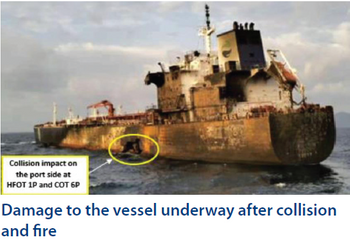
At about 0558, the OOW was still in the chartroom. The lookout pulled the curtain and called the OOW urgently. On his return, the OOW saw a large ship at anchor less than a cable ahead with the deck lights on. This was Target 46. The OOW immediately switched to manual steering and applied hard starboard rudder. Despite the manoeuvre, and still making 14 knots, a collision was unavoidable. At approximately 0602, Tanker A’s bow contacted Target 46’s port anchor chain. The anchor chain entangled with their port bilge keel drawing the vessels closer. Target 46’s bulbous bow breached Tanker A’s shell plating and caused a fire on both ships. Target 46’s bow flare also struck the tanker’s port bridge wing, partially detaching it. The Master of Tanker A arrived on the bridge to a near apocalyptic scene of fires on deck and a partially destroyed bridge. He broadcast a MayDay distress call requesting immediate assistance.
The Master soon issued an abandon ship order. Flames engulfed the port side of the accommodation, and smoke spread to the starboard side. Initial attempts to launch the life rafts were stopped after fire was observed on the sea surface. Later, evacuation was possible and all 22 crew were eventually rescued.
Meanwhile, Target 46, also a tanker, was now adrift, its anchor chain broken from the impact, and the crew were fighting fires on board. Eventually, all crew were rescued from this vessel as well but one shore worker that had been on board died of injuries.
The investigation found, among other things, that the OOW had had only about two hours of rest in a 38.5-hour period since leaving his home and joining the vessel, and was likely experiencing fatigue. This could have reduced his performance and judgement during the developing closequarters situation. The investigation also found that the anchored vessel had attempted to warn the oncoming tanker with the ALDIS lamp and sound signals, but these were ineffective. Despite the escalating risk, VHF was not used as an additional means of communication, which could have supported situational clarification.
Lessons learned
- Two vessels underway colliding may end in an even distribution of responsibility, but colliding with an anchored vessel is usually more one sided against the vessel underway.
- Why did the OOW feel it necessary to attend to administrative duties while navigating at night in a busy waterway? Are vessels adequately manned to account for administrative burdens imposed by today’s maritime environment?
- Attending to any other duties except navigation while in charge of a watch is a recipe for disaster.
- With only about two hours of rest in a 38.5- hour period before the collision (due to travel to the ship among others), it is almost certain the OOW was experiencing fatigue, which negatively affects performance and judgement. At a minimum, travel time to join a ship should be counted as time on board for the purposes of work/rest calculations.
- Given that: ISM requires companies to establish safeguards against all identified risks; Sufficient restorative sleep is the only antidote for fatigue; It follows that, over and above work/’rest’ calculations, companies should endeavour to ensure, through manning levels, procedures and safety culture messaging, that their crew have had sufficient restorative sleep before working.
As edited from TSIB (Singapore) report TIB/MAI/CAS.173
