

202623 Pilot boat hits rocks
As edited from TAIC (New Zealand) report MO-2024-207 https://taic.org.nz/inquiry/mo-2024-207
A pilot boat Master was finishing his port departure checks before taking a pilot out to board an inbound cargo ship. By 0420, the predeparture checks were completed and about five minutes later the pilot boarded. The pilot boat left the berth at about 0430.
The pilot boat’s captain estimated that the visibility at ground level was less than 0.5 nautical miles, so they steered the vessel parallel to the town docks as they headed out. Soon, they passed north of a buoy and the captain turned the pilot boat into the main channel. They followed the starboard side of the channel and increased speed to about 15–18 kt speed over ground (SOG).
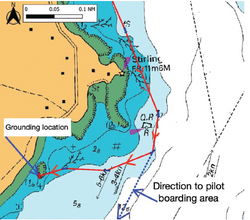
Because of the restricted visibility, the pilot boat’s deckhand stood in the forward part of the wheelhouse as lookout. At about 0435, they altered course to starboard to continue towards the pilot boarding area. The captain was looking for the silhouette of a local promontory as the next visual reference to steer by.
Shortly after the alteration of course to starboard, the deckhand noticed that the chart plotter and radar screens showed the vessel heading towards the land and he told the captain. The captain looked down to check the screens and realised that the vessel was not where it should have been. A few seconds later, the vessel ran aground with both engines still running. The captain attempted to back off by putting both engines astern, but realised that would be ineffective when they saw rocks on both sides of the vessel and astern.
At about 0603, a Coastguard vessel towed the pilot boat off the rocks. Once the pilot boat was afloat and clear of the rocks, it became apparent that the steering was not functioning and only the port engine was running. The pilot vessel was towed into port by an attending vessel.
The investigation found, among other:
- The Master’s situational awareness was significantly reduced by the state of the visibility and their navigation methods. As a result, at a certain point the boat turned too far to starboard and the vessel ran aground.
- The vessel had sufficient electronic navigation instruments to support navigation in restricted visibility. At the time of the accident, these instruments were switched on, but the captain was not using them to verify the vessel’s position and progress.
- At the time of the accident, the pilot boat operating company did not require assessment of the ongoing proficiency of pilot vessel captains. This omission meant that there was no formal verification that navigation practices on board the pilot vessel continued to meet industry best practice.
Lessons learned
- Navigating using exclusively visual means in reduced visibility, even in well-known waters, is a recipe for an accident. See MARS 202154 for a similar situation.
- Speed through the water should be proportional to the quality of your situational awareness. This accident was in part due to ignoring this rule; that is, proceeding at high speed with a low situational awareness.
As edited from TAIC (New Zealand) report MO-2024-207 https://taic.org.nz/inquiry/mo-2024-207
