

202613 Watertight door fatality
As edited from KMST (Republic of Korea) report 2023-002
A research vessel was at sea with no apparent rolling or pitching. An engine room crew member was undertaking maintenance on one of the watertight doors. He opened the cover of the door’s power switchboard on the bulkhead and checked its condition. The switchboard’s power was off.
He then opened the lower panel of the actuating system where the watertight door’s control lever was installed, checked the hydraulic gauges, electric motors, and other items, and cleaned the inside. The watertight door remained closed throughout the process. He then took a short break, walking to the smoking area and chatting with other crew.
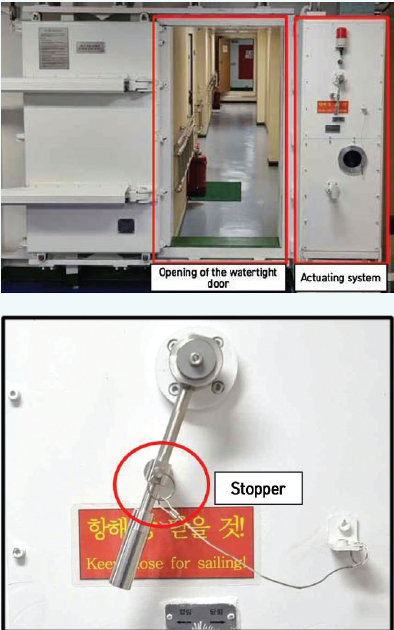
After his break, he returned to the watertight door under maintenance and attempted to open it, probably intending to check the door’s condition, or to simply to save time by going through the watertight door instead of the regular door on the other side. When the door was closed, as it normally was, a stopper was always put into the hole of its control lever in the corridor.
The crew member took out the stopper and opened the watertight door by turning and holding the lever to the right – the opening direction. Since the power switchboard for the watertight door was turned off, the door was operated by residual hydraulic pressure in the accumulator. Normally an alarm signal and visual strobe would sound/flash when opening or closing but since the power was off, there was no signal.
He probably intended to pass through the door, then close it while simultaneously putting the stopper into the control lever. While standing in the middle of the watertight door frame, he pushed the corridor-side control lever in the closing direction with his left hand. The residual hydraulic pressure then caused the door to return to the closing direction.
As the door was closing, he tried to put the stopper into the control lever, but somehow got trapped in the closing door. The watertight door pressed down on him powerfully from behind. The force of the closing door would have been weaker than the normal set pressure, but it was strong enough to trap him in the door.
It takes about 25 seconds for a watertight door to reclose. The time needed to trap the victim was likely to have been much shorter, given the space occupied by the victim who was standing and the remaining width of the watertight door.
Within minutes the victim was discovered trapped between the watertight door and its frame. The victim’s body did not move but the arriving crew opened the door manually. The victim had stopped breathing and had no pulse.
The investigation found that the stopper on the actuating system had been installed in case the door needed to remain open for a long time during inspection or while work was being carried out. When the door is opened, its control lever is in neutral. As long as the lever is not turned to the closing direction, the door remains opened. The stopper is intended to prevent the door closing if the lever is activated due to negligence or malfunction.
The vessel’s crew did not clearly understand the function of the stopper. They believed, incorrectly, that it was a safety pin which had to be inserted so that the control lever could not move. The victim probably also regarded it as a safety pin that should remain inserted. In other words, the victim’s belief that he had to insert the stopper is likely to have contributed to this accident, along with his decision to pass through the door.
Lessons learned
- It appears the crew were not very familiar with the use and operation of the watertight doors, and specifically the rationale for the ‘stoppers’.
- It should be second nature to use Lock out tag out (LOTO) procedures for any machinery that has stored potential energy, to ensure safe operations. If you don’t buy your LOTO ticket, you will never win!
- Watertight doors are an integral part of the safety of the ships that are fitted with them. Yet the doors themselves contain stored energy and potential for great harm. All crew on ships with watertight doors should be completely conversant with their operation.