202601 Near disaster in fog
As edited from SHK (Sweden) report 2025-16
Seven decommissioned yet still operational small military boats had been organised to allow the public to have access and enjoy a short ride of approximately 30 minutes in the immediate area of the port. The one-day event was touted as ‘A Day in Paradise’.
On the day of the event, there was thick fog in the area. The crews of all seven vessels agreed on the route to be followed. To offer the best possible experience for the passengers, the slower vessels would depart first, to be overtaken during the cruise by the fast-moving vessels. Ship A, a 45 metre former missile/torpedo boat capable of high speeds, would leave last.
A first trip was completed in the morning, but the speed of the participating vessels was reduced due to the thick fog. For the second trip, the visibility was slightly better, possibly between 100m-200 metres. At one point there was some confusion among the participating vessels. One vessel made several course alterations to avoid a close encounter, bringing it ‘out of formation’. This was noticed on Ship A, which was at this point making about 30 knots.
The crew on Ship A noticed another echo on the radar, which they could not identify, nor determine in which direction it was moving. The crew were unable to use the automatic plotting device available on the radar as they were unfamiliar with its full function. The Master used an app on a mobile phone to try and see if the echo was a vessel with AIS. However, the app did not show vessel symbols.
The crew of Ship A did not realise that the echo was Ship B, which was not part of the event but a regular small passenger ferry making way at a speed of 15 knots.
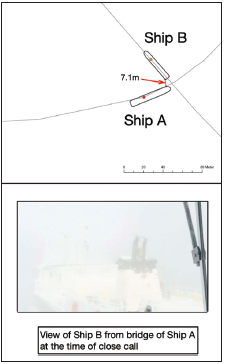
Ship B’s crew saw that Ship A was on a southerly course and assumed that Ship A would pass portto- port and then astern of them. But then, Ship A turned to port to an easterly course at about 35 knots, bringing it on a collision course with Ship B. When the Master of Ship B saw that Ship A was heading directly towards them, he turned to starboard in an attempt to avoid collision. The bridge team on Ship A saw Ship B at the last minute and were unable to make any changes to their speed or direction. They passed astern of Ship B at about 7 metres distance.
The investigation found, among other things, that the reason the speed was not reduced on Ship A was that the bridge team felt the conditions were excellent for radar, where even echoes from small objects appeared clearly on the screen. The bridge team thus felt that they had control of the situation despite the dense fog. However, the high speed meant that the OOW and the Master had very little time to perceive, discuss, and analyse the radar image. They did not understand that they had lost their situational awareness of the surrounding traffic.
Lessons learned
- Only good fortune prevented this close call from being a disaster. Given the high speed of Ship A and the fact that there were passengers on the foredeck, an impact with Ship B would probably have resulted in multiple fatalities.
- Once again, high speed in reduced visibility created a dangerous situation. Slow down in fog!
- Using a telephone app to help identify other vessels is not professional nor a recommended practice. Use proper navigation instruments to their utmost.
Editor’s note:
This close call is a good example of how luck plays a role in consequences and how every close call is just as significant as an actual accident. Had Ship A started to alter course to port just 0.5 seconds earlier, the vessels would have collided. The lesson to be retained: report and analyse all close calls!
As edited from SHK (Sweden) report 2025-16