
Seaways All hands on tech - May 2026
Where technology, data and human competence converge
by Capt Ann Pletschke CMMar FNI, STEER Project Manager
We are entering a period where technology, data, and human expertise are converging at an unprecedented pace. That convergence will shape not only the future of maritime work, but the future of maritime professionals.
Ships are becoming smarter, with more connected systems and ever-morecapable automation. All these systems are still being driven by humans at the design, operation and analytical levels. In fact, we quite often see vessels up-manning when DP is used for project work, despite their high automation. Human competence is needed as much, if not more, as systems become more complex.
At the same time, technology on ships and offshore operations is evolving faster than ever. Sensors monitor engines and machinery continuously and life at sea can feel a bit like the Big Brother house with CCTV recording our steps and the VDR recording our 12-4 caffeine-fuelled ramblings. Navigation systems and sensor fusion integrate satellite positioning, environmental sensors and digital charting. S-100 and S-200 standards are set to transform how we interact navigationally.
We are seeing automation increase in complexity in all areas of vessel operations, such as propulsion management, cargo handling and navigational planning.
This is an important point– increased automation and even maritime autonomy does not remove the need for maritime professionals.
What it does is change the nature of maritime work. This is not a new phenomenon. Many of us remember radio officers who retrained as electricians as GMDSS steamrollered in. Today, many of those original electricians are now known as ETOs. Maritime work has always been a place of change, but what mariners are good at is adapting. And we typically upskill as we do.
The seafarer of the future will increasingly operate in a hybrid environment where physical vessels, remote operations centres, robotics, analytical control hubs and data centres all interact. Seafarers are no longer equipment operators but instead, complex systems managers.
Seafaring sometimes feels a little like juggling multiple balls, where we must interpret alarms, analyse system data, manage automation and respond effectively when technology fails.
The maritime professional is evolving into being a technology integrator. We have seen it in recent decades with Integrated Bridge Systems and Unmanned Machinery alarm systems – with the advent of AI, digitisation and advanced sensor technologies, integrating systems is showing no signs of abating for the mariner.
That evolution places new demands on training, skills and professional development. But it also creates opportunities. With the changing landscape of AI, energy developments and data-driven ships, what will define the maritime professional of the future?
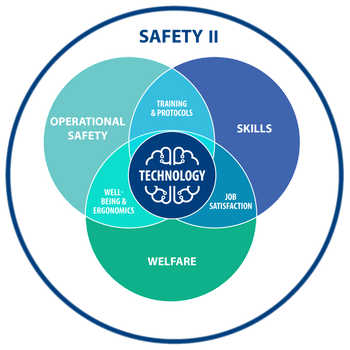
Through the work we are doing in the STEER Project, three themes consistently emerge: operational safety, skills, and seafarer wellbeing.
Safe operations already depend on the interaction between a competent seafarer and reliable technology, with many an accident report showing what happens when this interaction is compromised. How seafarers manage and respond to technology not performing as expected will be every bit as important to safe operation as traditional seamanship skills.
On the topic of skills, we can see how the role of the seafarer is evolving.
The introduction of ECDIS showed us how introducing technologies without adequate seafarer training frameworks carries enormous risk. It is of course not enough to have just a framework. Training in new technologies can become very chickenand- egg, in needing trainers with suitable experience to train, when technologies are new and evolving.
We also cannot discuss technology without considering seafarer welfare. We have seen how increased connectivity is supporting seafarers. This connectivity can however also bring additional pressures: information overload, additional avenues for onboard harassment and the need to manage emotions with evolving situations at home such as a bereavement, illness or even a child asking for help fixing their car. Connectivity brings constant emotional demands and distractions to a level that seafarers have never experienced before. Supporting the wellbeing of seafarers through this transition is therefore essential. Regardless of how advanced technology becomes, ships will always operate in unpredictable environments. The judgement, experience and professionalism of seafarers keeps operations safe, irrespective of technology.
The maritime industry has always evolved. From sail to steam, celestial to satellite navigation. Every transition across the centuries has required new skills but also created new opportunities. For seafarers across the globe, there are opportunities to be had. If managed well, technological advancements can enable an industry that will be safer, more sustainable and more resilient than ever before. Achieving that future however means ensuring that seafarers must remain at the centre of technological change. Do you feel like a system operator or a data manager at times?
Do you feel confident in managing technology if it fails? Above all, do you consider you have adequate training to understand all the technologies and systems that you use onboard? This will be the topic this month being discussed on our forum and on our STEER Project LinkedIn channel.