202629 Collision in fog in a TSS
A loaded bulk carrier, Vessel A, was underway in a Traffic Separation Scheme (TSS) in fog, making about 7.6 kts. Visibility was about 350 m, so the Master had put in place a heightened bridge watch regime.
The Master had the con, assisted by two other navigation officers, and there was a helmsperson at the wheel.
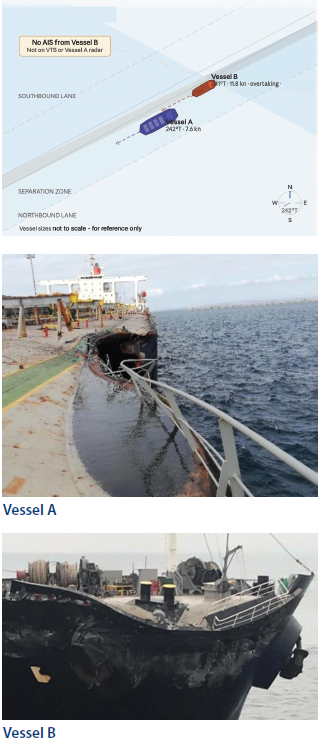
Despite these precautions, the bridge team of vessel A were not aware that they were being overtaken by vessel B, behind them. Vessel B’s radar return was intermittent, and Vessel A had not plotted it as a radar target. Vessel B was not emitting an AIS signal. Neither vessel was sounding the one long blast every two minutes required in restricted visibility by the collision regulations.
Vessel B was overtaking vessel A at full ahead, making about 11.8 kts. The bridge of vessel B was manned by a OOW and a lookout, with the helm on autopilot. The OOW of vessel B was aware of vessel A, but had not informed the Master of the reduced visibility.
Vessel Traffic Services (VTS) contacted vessel A to instruct them to go to anchorage or drifting as visibility in the TSS was too low and traffic was now suspended. A few minutes later, when the Master saw that the opposite traffic lane was free, he ordered slow ahead on the engine and port helm to cross the lane to comply with the suspension order. The VTS agreed with this alteration, but the VTS operator was also ignorant of the exact position of vessel B, since there was no AIS transmission and the vessel’s radar return was intermittent.
The OOW on vessel B became concerned about the developing close quarters situation and called vessel A on the VHF. Vessel A responded but there was no follow-up conversation. Within seconds the two vessels were in sight of one another. The Master of vessel A, now realising that vessel B was close behind, ordered hard to starboard to avoid a collision. On vessel B, the OOW put the helm hard to port, but a collision was now inevitable, and they struck vessel A on its port side. Damage was important on both vessels.
Lessons Learned
- AIS is an important watchkeeping tool but not foolproof. Overreliance on AIS targets on your radar can damage your situational awareness.
- ARPA and AIS are complementary systems, and in restricted visibility all contacts – whether AISequipped or not – must be tracked on radar.
- Speed in restricted visibility must reflect the stopping capability relative to visible range. Vessel B was making 11.8 knots in dense fog in a congested TSS. At that speed and at close range to another vessel, minimal time for collision avoidance was available.
- Bridge team composition must reflect actual conditions, not watch schedule defaults.
- Even adequate bridge team composition when in reduced visibility, as with vessel A, is not a failsafe for faultless operations. In the case of vessel A, BRM and bridge team situational awareness were less than adequate thus negating the effect of a reinforced bridge team.
As edited from UEIM (Turkiye) report 13 /D-6 /2023