

202606 You snooze you lose
As edited from MAIB (UK) report 26/2013
A small coastal general cargo vessel left port at 23:00. At 23:55 the second officer relieved the Master as OOW. The second officer felt normal and capable of keeping his watch, but there was no lookout assigned to that watch. After plotting the vessel’s midnight position on the chart, the Master handed the watch over and went to his cabin to sleep about 40 minutes later.
At 02:56, the vessel had reached a course alteration waypoint, and the OOW adjusted the vessel’s course. He then went out to the starboard bridge wing to get some fresh air. When he returned inside, he secured the starboard bridge door in the fully open position and sat in the port bridge chair. Shortly afterwards, he fell asleep. The vessel passed the next planned waypoint and maintained its course for just over 2.5 miles, at about 10.5 knots, until the OOW woke up.
Sensing danger, the OOW immediately moved the engine control to neutral, and then full astern, but the vessel grounded nonetheless at 03:22. The Master was woken by the resulting noise and vibration, came to the bridge and sounded the alarm.
The crew mustered with lifejackets and survival suits. The Master ordered the rescue boat launched so he could carry out an external inspection of the vessel. While the rescue boat was being launched, the Master informed the management company that the vessel was aground, and other members of the crew were sent to open and ventilate the forepeak tank.
After completing his external inspection from the rescue boat, the Master returned on board and internally inspected the forepeak tank and duct keel. At the time of this inspection, there was no water ingress to the vessel. However, with the rising tide, the bow thruster space began to flood.
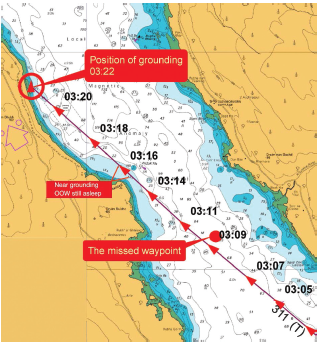
Later that day the crew carried out a temporary repair to stem the flooding. The vessel was re-floated at 21:20, making way for a port of refuge. After an inspection the vessel was found to have sustained significant bottom plate and frame damage to the forward part of the hull. Following the inspection, the vessel proceeded to another port to be repaired.
Lessons learned
- It is likely the BNWAS alarm was not activated.
- Once again, the OOW was alone on the bridge at night; a precursor for possible bad outcomes.
- Once again, sitting in a chair at night is step one in a two-step sequence of falling asleep on watch.
As edited from MAIB (UK) report 26/2013
