
202602 Passenger ship side window failure
As edited from NSIA (Norway) report MARINE 2023/06
A passenger ship was on a steady northbound course travelling at a speed of about 16 knots. Although the weather was worsening, there was not much movement in the ship. Bridge crew noticed that while waves were coming from the same direction as they had been earlier in the voyage, they were now somewhat larger, but the ship was stable and did not roll much. The waves lifted the ship slightly, but they were not crashing against the side of the ship, nor were there any concerns relating to the ship’s movements.
During the next half hour, sea spray reached the bridge several times. At one point, a powerful wave hit the port side of the ship. The bridge team heard a crash, and for a moment they could not see out of the bridge windows because of the wave washing up the ship.
Items fell to the floor, and the ship vibrated briefly. Several of the passengers and crew members had to brace themselves so as not to fall over, and some people fell out of chairs. Shortly after, an alarm went off indicating that the smoke detectors on deck 2 were disconnected. The staff captain went down to deck 2 to survey the situation, arriving about three minutes after the impact.
The staff captain called the bridge to inform them that there was water ingress and suggested the vessel change course immediately to reduce the waves on the port side. Crew proceeded to their posts according to the announced emergency code, and passengers began to emerge from an area of the vessel which had been damaged. Medical personnel on board were called as several of the passengers had sustained injuries.
A clearer picture of the extent of the damage became evident, and as the damage appeared to be limited to a relatively small area and the emergency was considered under control, a general muster was not initiated. Passengers were instructed to remain in their cabins, except for the passengers in the damaged area, who were instructed to proceed to deck A. It was later found that seven cabin windows on the port side of deck 2, approximately 8 metres above the waterline, had shattered when the wave struck the ship.
Onboard medical personnel confirmed that eight passengers had suffered minor physical injuries. One other passenger was found deceased in an affected stateroom. The victim was found on the deck under various parts of the damaged stateroom.
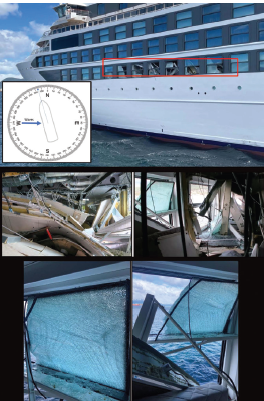
The course was set for a port of refuge, and the Master ordered the damaged area to be monitored until they arrived in sheltered waters. The investigation found that the sea conditions at the time of the accident were within the sea states defined in the specifications to which the ship was designed, yet the wave forces acting on the windows were significantly higher than their design state.
Lessons learned
- At the time of the accident, the crew did not have sufficient information to predict the risk associated with a strong breaking wave reaching high up on the ship side.
- The current design pressure requirements for windows on a ship’s side appear to yield values that are too low to withstand real-world pressure loads from breaking waves.
As edited from NSIA (Norway) report MARINE 2023/06