Seaways Captain's Column: Standing orders
by Cezary Leszczynski
Every Master has standing orders. Most OOWs compare one captain’s instructions with another’s, and the differences can sometimes be striking. In general, standing orders are a framework that allows the mate to act decisively and consistently, knowing exactly where the Master has drawn the limits. While the details vary between ships, companies and Masters, the process of defining and communicating those limits is common to all good bridge teams.
I have refined my own standing orders to reflect some peculiarities of the type of vessels on which I work: deep draft; at times limited manoeuvrability; slow speed that means they have a tendency to lag behind surrounding traffic; the particular composition of the bridge team, with two mates on watch – navigator and co-navigator. My orders are not just about what to do, but when to act. They set boundaries that remove uncertainty, giving my officers the confidence to make timely, visible decisions without hesitation, while knowing exactly when they need to call me to the bridge.
Principle over speed
At the heart of the orders is a simple priority: safety over time or distance saved. An ETA is not worth the risk of collision, grounding or near-miss.
Even if I am on the bridge, the OOW retains responsibility until I formally state that I have the con. That clarity prevents the dangerous grey area where Master and officer both think the other is in charge. Where I am in fact in charge (narrow Straits, a port entry, etc.), I make it clear that while I bear the overall responsibility and accountability, I expect my officers to be aware of what’s going on, understand it – and speak up if they do not. Situational Awareness and Bridge Team Management concepts stay in force, no matter who has the con.
Taking over a watch
I ask officers to take their time during watch handover: adjust their eyes, look out through the window and radar screens, review the route plan for at least two hours ahead (beyond their watch), check navigation lights and equipment, confirm weather reports, monitor ECDIS. One small but important instruction is that they should not relieve a colleague while the vessel is in the middle of a manoeuvre. Continuity of judgement in those crucial minutes is worth more than a punctual changeover.
When to call me
Most Masters say ‘Call me if in doubt.’ I prefer to remove that doubt by spelling out thresholds within my own comfort zone for the waters in question.
These numbers are not theoretical or picked at random. They are different in open waters from when passing near the coast – and are naturally tighter in restricted waters. They are the absolute minimum values which I don’t like OOWs to go below. If they unable to keep the minimum distance given, they are to call me. Small margins can disappear in an instant, as we know.
What does that look like in practice? Call me when visibility drops below x miles; if CPA cannot be kept above y cables or if Bow Crossing Distance threatens to fall below z miles. TCPA at m minutes or a distance of d miles from another vessel head-on (whichever comes first) is another trigger.
These limits may look arbitrary, but they are the heart of my standing orders. They reflect the handling capability of the ship, the need for conservative margins in various situations and areas, and ultimately my own risk tolerance. By writing them down, I eliminate hesitation. A mate who might otherwise be uncertain whether to act or to call now has a clear framework. They know that if they are unable to maintain the limits set, then I’d like to be called to the bridge.
Where there are no numbers? Call me for any equipment failures, propulsion problems or traffic situations where there is disagreement about the correct action.
Collision avoidance
My standing orders emphasise early and visible action. On the vessels on which I work, reducing speed is often the easiest, quickest and most effective tool to reduce risk, yet a heading change is the first choice (this corresponds to Colregs). Officers know not to use more than 35 degrees of thruster turn at once, as anything larger risks dangerous list.
I remind them never to assume the other ship will comply with Colregs. If the CPA is projected to be below three cables, they are to treat it as zero.
In overtaking situations, I like to request others to pass with more than one mile clearance in open waters (or call me). That margin allows for mechanical breakdowns or human error from either ship. Once a vessel is overtaking, it remains the overtaker until well past. If we are the stand-on vessel being overtaken, officers are reminded that as per Colregs, they are to keep course and speed unless forced to alter for another conflict – in which case they must clearly inform the overtaking vessel.
Head-on, crossing, restricted visibility
For head-on encounters, where both power-driven vessels must act, I require mates to act early. They should alter to starboard with not less than 20 minutes TCPA or at a distance of eight miles, whichever comes first.
In crossing situations in open waters, if we are the give-way vessel, the order is to act positively before TCPA falls to 30 minutes. If we are the stand-on vessel, and the give-way vessel does nothing, then we should act ourselves not later than 20 minutes TCPA, if the give-way vessel does not take action after our five short blasts.
In restricted visibility the stand-on concept disappears – both vessels must act. My orders state that if officers detect a target forward of the beam with a risk of collision (and/or close quarters situation), they should manoeuvre so that the echo is placed abeam without crossing ahead.
Rule 2 is to be applied only to avoid an immediate danger.
Managing multiple encounters
Busy traffic areas often involve several developing situations at once. My orders emphasise prioritisation: assess TCPA and CPA, work radar on two ranges simultaneously. If possible, avoid crowded groups by going around them. If this is not possible, seek openings to move through the group, rather than forcing a way through.
VHF use
I make it clear that VHF is not a substitute for compliance with Colregs. It must not be used to agree Colregscontradictory manoeuvres such as ‘green-to-green’ in a head-on situation.
Human factors
My orders recognise the limits of equipment and people alike. The radar picture must always be checked against the visual scene, especially in rain, where small boats or fishing gear may be not visible on screen. Look-out means visual, audible, AIS and radar. Fatigue is treated as a safety hazard; officers must be fit (mentally and physically) when they take the watch. Personal phones, tablets or laptops are not allowed on the bridge during passage – distraction is the enemy of vigilance.
The red line
Standing orders are more than a set of instructions taped to the chart table. The list of limits itself is not the point here. What matters is that the bridge mates know where the red lines lie, and that they understand the reasoning behind them. Each Master may define their own limits, based on their ship, their waters and their experience.
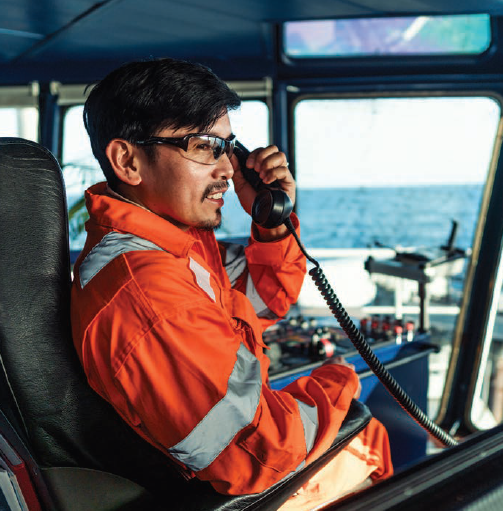
My standing orders are simply one expression of a wider truth: that safety at sea depends not only on rules, but on clarity, communication and the confidence to act before a situation becomes critical. Like that, an OOW confronted with developing traffic does not need to guess what the Master expects; the expectations are written, discussed and understood. By removing ambiguity, the OOW is never left unsure whether to pick up the phone.