

202609 BRM AWOL
A fully laden tanker was making a berthing approach under pilotage in clear weather, light winds and in daylight. The Master, Chief Mate and a helmsman were all on the bridge. The bridge team and pilot were all very familiar with this berth. The initial Master/Pilot Exchange (MPX), more than three hours prior to the berthing manoeuvre, was interrupted by radio traffic and somewhat perfunctory, probably due to this familiarity. The MPX did not include details of the final turn and approach to the berth. None of the bridge team were assigned tasks by the pilot to assist the manoeuvre, nor did they assume tasks and report to the pilot.
The pilot was using a Portable Pilotage Unit (PPU), in this case a tablet, connected to the ship so that the ship’s characteristics and navigational information were available to the PPU. The PPU was also wirelessly connected to a portable exterior antenna that provided enhanced positional and rate of turn information. What could go wrong?
The plan was to dock port-side to, so two tugs were secured to the vessel’s starboard side. The berthing consisted of approaching the dock parallel and, when about five cables off, executing a 180-degree turn to starboard, and then pushing alongside with tugs as well as bow and stern thrusters.
At some point during the turn to starboard, or possibly before, the pilot began to rely exclusively on the PPU information; there was no cross check with other instruments or other members of the bridge team. During the turn, it appeared to the pilot, fixated on the PPU, that the ship was too close to a shoal buoy astern. To provide additional clearance he gave tug and engine orders to slow the swing of the vessel. The pilot explained the reasons for this action. The Master immediately verified the ECDIS and visually sighted the buoy. Although the Master found that the buoy was a considerable distance from their stern (400 to 500 metres away), he did not mention his findings to the pilot.
At various points of the operation the pilot, Master, and chief officer on the bridge, the second mate on deck forward (but not on the bow), and the operator of the forward tug, all noticed that something was not quite right with the approach. However, none of them signalled their unease. Soon the vessel struck the dock, bow on, at over one knot. Although damage to the vessel was relatively minor, resulting in a hole in the bow, damage to the unloading dock was major.
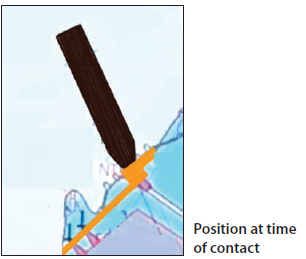
The investigation found, among other things, that the pilot had assumed his PPU ‘recognised’ the vessel as a frequent caller and that it had therefore automatically applied the antenna offet for this ship. In fact, the offsets were not loaded, which resulted in the displayed ship position on the PPU being more than 200 metres ‘astern’ of the true position. This error was not caught during the three hours + transit to the dock. By fixating on the PPU image, which was incorrect, the pilot was working on false assumptions.
Lessons learned
- Even with perfect weather conditions and in daylight, a well-maintained ship with tug assistance can still unwittingly be driven into a dock if BRM breaks down or is simply non‑existent.
- Notwithstanding experienced officers familiar with the port and a pilot, there was no shared mental model of the berth approach among the bridge team.
- Frequent callers and repetitive operations can, paradoxically, cause a lull in standards and lower levels of vigilance.
- An over-reliance on a single data source, in this case the PPU, can lead operators astray sufficiently to cause an accident, even against what should be overriding visual evidence out of the bridge windows that they are running into danger.
- When setting up a PPU, it is good practice to validate the position of the vessel on the PPU as compared to the vessel’s ECDIS, and to confirm all offsets if the pilot has installed a complementary portable antenna.
- With no one stationed on the ship’s forecastle or on the berth assigned to monitor progress and call out distances the bridge team lacked another important data input source.