201708 The lifejacket that didn’t float
Edited from US Coast Guard Safety Alert 07-2016
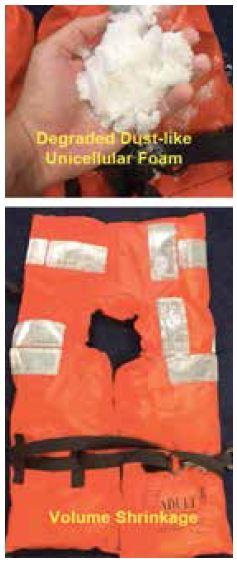
Recent inspections have found some vessels with inadequate lifejackets. The unicellular foam buoyant material within the nylon outer shell had degraded significantly over time, and in some instances was reduced to dust.
The lifejackets were properly stored, kept dry, and not under direct sunlight; however, the storage location was very hot at times. These particular lifejackets, manufactured in China, were the Type 1, 160RT model distributed by The Safeguard Corporation of Covington, Kentucky. They were approximately nine years old.
Lessons learned
Lifejackets should be regularly inspected for indications of failure or degradation, specifically for:
Compression: The lifejacket may be compressed from many years of stowage.
Loss of resiliency: The lifejacket is excessively hard, stiff or its foam is brittle. Normally after compressing the lifejacket to about half its initial thickness, the foam should expand to its original dimension in a short period of time.
Shrinkage: A physical reduction in size may be indicated by ‘wrinkling’ of the coating on vinyl dipped types or by a loose fitting shell on a fabric-covered lifejacket.